Finding the Truth in Social Business Directories

LinkedIn has a section called companies. When browsing around on LinkedIn you are sometimes hinted to follow a company that LinkedIn think will be of interest for you.

The other day my hint included two identical logo’s for the old Master Data Management (MDM) vendor called Siperian. Curiously and data quality geeky as I am I checked and actually there are two Siperians on LinkedIn companies:

Both have an identical head quarter address in California, USA.

So, even MDM vendors have created duplicates.

Also, Siperian was acquired by the Data Integration giant Informatica some years ago, so you should expect that the Siperians was emptied. But that is not the case. Some Siperian folks still claims working for one of the Siperian duplicates (though many also for Imformatica at the same time).

Now, I was not sure about the legal status of the old Siperian company. So I went to another social network called Companybook. On that site the company registry is based on an external business directory.

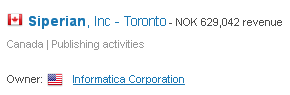
Here it seems that the Siperian company in Toronto, Canada actually still exist, though marked as owned by Informatica.

So, I’m still looking for that single source of the truth out there. Until then I will mashup the external sources out there with my internal MDM vendor knowledge as told in the post yesterday called Mashing Up Big Reference Data with Internal Master Data.

Bookmark and Share

Mashing Up Big Reference Data and Internal Master Data

Right now I’m working on a cloud service called instant Data Quality (iDQ™).

It is basically a very advanced search engine capable of being integrated into business processes in order to get data quality right the first time and at the same time reducing the time needed for looking up and entering contact data.

With iDQ™ you are able to look up what is known about a given address, company and individual person in external sources (I call these big reference data) and what is already known in internal master data.

From a data quality point of view this mashup helps with solving some of the core data quality issues almost every organization has to deal with, being:

  • Avoiding duplicates
  • Getting data as complete as possible
  • Ensuring maximal accuracy

The mashup is also a very good foundation for taking real-time decisions about master data survivorship.

The iDQ™ service helps with getting data quality right the first time. However, you also need Ongoing Data Maintenance in order to keep data at a high quality. Therefore iDQ™ is build for trigging into subscription services for external reference data.

At iDQ we are looking for partners world-wide who see the benefit of having such a cloud based master data service connected to providing business-to-business (B2B) and/or business-to-consumer (B2C) data services, data quality services and master data management solutions.

Here’s the contact data: http://instantdq.com/contact/

Bookmark and Share

The Cases for UPPER CASE in Data Management

I remember some years ago when I started SMS’ing I had an old mobile phone that defaulted the text in upper case. After I while my son answered back: “Why are you always yelling at me in SMSes”.

So I learned that you can use lower case in SMSes as well, and only using all caps in SMSes, as in any other writing, usually means that YOU ARE YELLING.

Examining a text for upper case use can, together with polarity classifiers and all that jazz, be used today in sentiment analysis for example within social media data.

Within data parsing using words in upper case in person names may tell you something too. Especially in France it is common to indicate a surname with only upper case characters, so for example in the name “AUGUST Michel” the first name is the surname and the last name is the given name.

When matching company names a word in upper case may indicate an abbreviation. So “THE Ltd” and “The Happy Entrepreneur Ltd” may be a good match despite of a horrible edit distance.

In data migration within handling names from older systems where all caps have been used, it is common to try to make better looking names. “JOHN SMITH” will be “John Smith” and “SAM MCCLOUD” should be “Sam McCloud”. In environments with other alphabets than English national characters may be reintroduced as well. For example in a German context “JURGEN VON LOW” may come out as “Jürgen von Löw”.

What about you? Have you stumbled upon some fun with upper case in data management?

Bookmark and Share

Data Driven Data Quality

In a recent article Loraine Lawson examines how a vast majority of executives describes their business as “data driven” and how the changing world of data must change our approach to data quality.

As said in the article the world has changed since many data quality tools were created. One aspect is that “there’s a growing business hunger for external, third-party data, which can be used to improve data quality”.

Embedding third-party data into data quality improvement especially in the party master data domain has been a big part of my data quality work for many years.

Some of the interesting new scenarios are:

Ongoing Data Maintenance from Many Sources

As explained in the article on Wikipedia about data quality services as the US National Change of Address (NCOA) service and similar services around the world has been around for many years as a basic use of external data for data quality improvement.

Using updates from business directories like the Dun & Bradstreet WorldBase and other national or industry specific directories is another example.

In the post Business Contact Reference Data I have a prediction saying that professional social networks may be a new source of ongoing data maintenance in the business-to-business (B2B) realm.

Using social data in business-to-consumer (B2C) activities is another option though also haunted with complex privacy considerations.

Near-Real-Time Data Enrichment

Besides updating changes of basic master data from business directories these directories typically also contains a lot of other data of value for business processes and analytics.

Address directories may also hold further information like demographic stereotype profiles, geo codes and property data elements.

Appending phone numbers from phone books and checking national suppression lists for mailing and phoning preferences are other forms of data enrichment used a lot related to direct marketing.

Traditionally these services have been implemented by sending database extracts to a service provider and receiving enriched files for uploading back from the service provider.

Lately I have worked with a new breed of self service data enrichment tools placed in the cloud making it possible for end users to easily configure what to enrich from a palette of address, business entity and consumer/citizen related third-party data and executing the request as close to real-time as the volume makes it possible.

Such services also include the good old duplicate check now much better informed by including third-party reference data.

Instant Data Quality in Data Entry

As discussed in the post Avoiding Contact Data Entry Flaws third-party reference data as address directories, business directories and consumer/citizen directories placed in the cloud may be used very efficiently in data entry functionality in order to get data quality right the first time and at the same time reduce the time spend in data entry work.

Not at least in a globalized world where names of people reflect the diversity of almost any nation today, where business names becomes more and more creative and data entry is done at shared service centers manned with people from cultures with other address formatting rules, there is an increased need for data entry assistance based on external reference data.

When mashing up advanced search in third-party data and internal master when doing data entry you will solve most of the common data quality issues around avoiding duplicates and getting data as complete and timely as needed from day one.

Bookmark and Share

Business Contact Reference Data

When working with selling data quality software tools and services I have often used external sources for business contact data and not at least when working with data matching and party master data management implementations in business-to-business (B2B) environments I have seen uploads of these data in CRM sources.

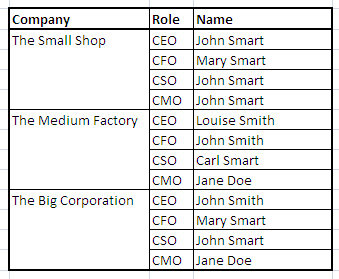
A typical external source for B2B contact data will look like this:

Some of the issues with such data are:

  • Some of the contact data names may be the same real world individual as told in the post Echoes in the Database
  • People change jobs all the time. The external lists will typically have entries verified some time ago and when you upload to your own databases, data will quickly become useless do to data decay.
  • When working with large companies in customer and other business partner roles you often won’t interact with the top level people, but people in lower levels not reflected in such external sources.

The rise of social networks has presented new opportunities for overcoming these challenges as examined in a post (written some years ago) called Who is working where doing what?

However, I haven’t seen so many attempts yet to automate and include working with social network profiles in business processes. Surely there are technical issues and not at least privacy considerations in doing so as discussed in the post Sharing Social Master Data.

Right now we have a discussion going on in the LinkedIn Social MDM group about examples of connecting social network profiles and master data management. Please add your experiences in the group here – and join if you aren’t already a member.

Bookmark and Share

Obscure Date and Time Formats

Date and time can be represented in many ways.

Here are some of the peculiar ones:

Roman Numerals

The Romans had a numbering system where letters from the Latin alphabet signified a value. Roman numerals are still used around the clock and many times for expressing a year something is build, written or made.

This year being 2012 in Arabic numerals is MMXII in Roman numerals. Next year is MMXIII and the year after is of course MMXIIII. No wait, it is MMXIV.

The 12-Hour Clock

A day consists of 24 hours. So naturally 5 hours into the day will be 5:00 and 17 hours into the day will be 17:00. But no. Several countries around the world still stick to the 12-hour clock writing 5:00 AM and 5:00 PM. And in most countries verbal use of the 12-hour clock is common.

The American Date Format

A date consists of three elements: Day, Month and Year.

So to most of the world yesterday the 1st June 2012 will be: 01/06/2012

If you insist using an ISO standard, you’ll do it backward: 2012-06-01

However, if you are from the United States, you’ll do it awkward: 06/01/2012

Even if you are a US data quality tool vendor selling to the whole world, you will still do it awkward:

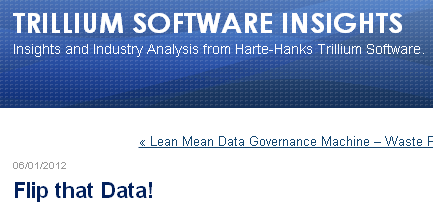
Blog post published 1st June 2012. Flip that date! – as it will be 6th January to the rest of the world.

Best practice will be writing June 1st 2012 or in other way avoiding ambiguity.

Bookmark and Share

Instant Data Enrichment

Data enrichment is one of the core activities within data quality improvement. Data enrichment is about updating your data in order to be more real world aligned by correcting and completing with data from external reference data sources.

Traditionally data enrichment has been a follow up activity to data matching and doing data matching as a prerequisite for data enrichment has been a good part of my data quality endeavor during the recent 15 years as reported in the post The GlobalMatchBox.

During the last couple of years I have tried to be part of the quest for doing something about poor data quality by moving the activities upstream. Upstream data quality prevention is better than downstream data cleansing wherever applicable. Doing the data enrichment at data capture is the fast track to improve data quality for example by avoiding contact data entry flaws.

It’s not that you have to enrich with all the possible data available from external sources at once. What is the most important thing is that you are able to link back to external sources without having to do (too much) fuzzy data matching later. Some examples:

  • Getting a standardized address at contact data entry makes it possible for you to easily link to sources with geo codes, property information and other location data at a later point.
  • Obtaining a company registration number or other legal entity identifier (LEI) at data entry makes it possible to enrich with a wealth of available data held in public and commercial sources.
  • Having a person’s name spelled according to available sources for the country in question helps a lot when you later have to match with other sources.

In that way your data will be fit for current and future multiple purposes.

Bookmark and Share

Avoiding Contact Data Entry Flaws

Contact data is the data domain most often mentioned when talking about data quality. Names and addresses and other identification data are constantly spelled wrong, or just different, by the employees responsible of entering party master data.

Cleansing data long time after it has been captured is a common way of dealing with this huge problem. However, preventing typos, wrong hearings and multi-cultural misunderstandings at data entry is a much better option wherever applicable.

I have worked with two different approaches to ensure the best data quality for contact data entered by employees. These approaches are:

  • Correction and
  • Assistance

Correction

With correction the data entry clerk, sales representative, customer service professional or whoever is entering the data will enter the name, address and other data into a form.

After submitting the form, or in some cases leaving each field on the form, the application will check the content against business rules and available reference data and return a warning or error message and perhaps a correction to the entered data.

As duplicated data is a very common data quality issue in contact data, a frequent example of such a prompt is a warning about that a similar contact record already exists in the system.

Assistance

With assistance we try to minimize the needed number of key strokes and interactively help with searching in available reference data.

For example when entering address data assistance based data entry will start with the highest geographical level:

  • If we are dealing with international data the country will set the context and know about if a state or province is needed.
  • Where postal codes (like ZIP) exists, this is the fast path to the city.
  • In some countries the postal code only covers one street (thoroughfare), so that’s settled by the postal code. In other situations we will usually have a limited number of streets that can be picked from a list or settled with the first characters.

(I guess many people know this approach from navigation devices for cars.)

When the valid address is known you may catch companies from business directories being on that address and, depending on the country in question, you may know citizens living there from phone directories and other sources and of course the internal party master data, thus avoiding entering what is already known about names and other data.

When catching business entities a search for a name in a business directory often leads to being able to pick a range of identification data and other valuable data and not at least a reference key to future data updates.

Lately I have worked intensively with an assistance based cloud service for business processes embracing contact data entry. We have some great testimonials about the advantages of such an approach here: instant Data Quality Testimonials.

Bookmark and Share

Deduplication vs Identity Resolution

When working with data matching you often finds that there basically is a bright view and a dark view.

Traditional data matching as seen in most data quality tools and master data management solutions is the bright view: Being about finding duplicates and making a “single customer view”. Identity resolution is the dark view: Preventing fraud and catching criminals, terrorists and other villains.

These two poles were discussed in a blog post and the following comments last year. The post was called What is Identity Resolution?

While deduplication and identity resolution may be treated as polar opposites and seemingly contrary disciplines they are in my eyes interconnected and interdependent. Yin and Yang Data Quality.

At the MDM Summit in London last month one session was about the Golden Nominal, Creating a Single Record View. Here Corinne Brazier, Force Records Manager at the West Midlands Police in the UK told about how a traditional data quality tool with some matching capabilities was used to deal with “customers” who don’t want to be recognized.

In the post How to Avoid Losing 5 Billion Euros it was examined how both traditional data matching tools and identity screening services can be used to prevent and discover fraudulent behavior.

Deduplication becomes better when some element of identity resolution is added to the process. That includes embracing big reference data in the process. Knowing what is known in available sources about the addresses that is being matched helps. Knowing what is known in business directories about companies helps. Knowing what is known in appropriate citizen directories when deduping records holding data about individuals helps.

Identity Resolution techniques is based on the same data matching algorithms we use for deduplication. Here for example a fuzzy search technology helps a lot compared to using wildcards. And of course the same sources as mentioned above are a key to the resolution.

Right now I’m dipping deep into the world of big reference data as address directories, business directories, citizen directories and the next big thing being social network profiles. I have no doubt about that deduplication and identity resolution will be more yinyang than yin and yang in the future.

Bookmark and Share

How to Avoid Losing 5 Billion Euros

Two years ago I made a blog post about how 5 billion Euros were lost due to bad identity resolution at European authorities. The post was called Big Time ROI in Identity Resolution.

In the carbon trade scam criminals were able to trick authorities with fraudulent names and addresses.

One way of possible discovery of the fraudster’s pattern of interrelated names and physical and digital locations was, as explained in the post, to have used an “off the shelf” data matching tool in order to achieve what is sometimes called non-obvious relationship awareness. When examining the data I used the Omikron Data Quality Center.

Another and more proactive way would have been upstream prevention by screening identity at data capture.

Identity checking may be a lot of work you don’t want to include in business processes with high volume of master data capture, and not at least screening the identity of companies and individuals on foreign addresses seems a daunting task.

One way to help with overcoming the time used on identity screening covering many countries is using a service that embraces many data sources from many countries at the same time. A core technology in doing so is cloud service brokerage. Here your IT department only has to deal with one interface opposite to having to find, test and maintain hundreds of different cloud services for getting the right data available in business processes.

Right now I’m working with such a solution called instant Data Quality (iDQ).

Really hope there’s more organisations and organizations out there wanting to avoid losing 5 billion Euros, Pounds, Dollars, Rupees, Whatever or even a little bit less.

Bookmark and Share