Today’s guest blog post is from Dan O’Connor, a United States based product data taxonomy guru. Here are Dan’s thoughts on product data quality:
I have had a few days off this past week while I transition to a new role. During that time, I’ve had time to reflect on many things, as well as pursue some personal interests. I talked with peers and former co-workers, added a fresh coat of paint to my basement, and worked on some WWII era bomber models I purchased before Christmas but never had time for.
 The third pursuit was a rather interesting lesson in paying attention to details. The instructions would say to paint an individual piece one color, but that piece would comprise of several elements that should never be painted a single color. For example, the flight yokes on Mitchell were planned to be painted black, but in viewing pictures online I saw that certain parts were white, red and aluminum. I therefore painted them appropriately. These yokes are less than an inch long and a couple millimeters wide, but became much more impressive with an appropriate smattering of color.
Flight Yokes and Product Taxonomies
It is this attention to detail that made me think about how product taxonomies are developed. Some companies just follow the instructions, and end up with figurative “black flight yokes”. These taxonomies perform adequately, allowing a base level of product detail to be established. Web sites and catalogs can be fed with data and all is well.
Other companies see past the black flight yokes. They need the red buttons, the white grips, and the silver knobs because they know these data points are what make their product data more real. They could have followed the instructions, but being better than the instructions was more important.
Imagine for a second that the instructions were the mother of the data and the plane itself was the father. According to the mother plain black flight yokes are sufficient. The father, while capable of being so much more, ends up with the dull data the mother provides. Similarly, if the plane/father has no options that allow it to be more colorful the instructions from the mother are meaningless beyond the most basic interpretations.
The Mother and Father of Product Data
To some my analogy might be a stretch, but think of it in these terms: Your product taxonomy is the mother of your product data, and the architecture that supports that taxonomy is the father. If your taxonomy only supports a generic level of data, the architecture supporting it cannot add more detail. If the architecture is limited the most robust product taxonomy will still only support the most basic of data. Your product data quality is limited by the taxonomy you build and the systems you use to manage it. If both are well-developed beautiful product data is born. If one or both is limited your product data will be an ugly mess.
Why is this important? Product data does more than validate the image has the right color on a web site, or make sure an item will fit in your kitchen or TV room. Product data feeds faceting experiences so that customers to your web site can filter down to the perfect product. Without facets customers have to search manually through more products, and may get frustrated and leave your web site before finding the item they want.
Product data also can feed web site search, allowing customers to find your products using product descriptors instead of just product numbers and short descriptions. These search options also filter out unnecessary results, allowing a customer to find the perfect product faster.
Product data might also be used by the marketplaces that sell your data, your catalogs, product data sheets, and even your shelf tags in your retail locations. Having one consistent source of data for those usages avoids customer confusion when they approach your business from an omni-channel perspective. Having to find a product on a shelf when the mobile experience has a different description is painful and leads to bad customer experiences.
Lastly, moving data between your business and others is problematic at the best of times. Poor product data leads to bad data dissemination, which leads to bad customer experiences across your syndication channels. If you cannot represent your data in a single logically message internally your external message will be chaotic and confusing for your guests.
The Elements of a Product Data Program
Therefore, creating a good product taxonomy is not just about hiring a bunch of taxonomists and having them create a product taxonomy. It is about taxonomy best practices, data governance, and understanding your entire product data usage ecosystem, both internally and externally. It is understanding what role Product Information Management systems play in data management, and more importantly what role they do not.
Therefore, in the analogy of a mother product taxonomy and a father architecture creating data, there are siblings, aunts, uncles, and other relatives to understand as well. A lack of understanding in any one of these relationships can cause adverse data quality issues to shine through. It is estimated that companies lose an average of $8 Million US dollars a year (ROI on Data Quality, 2014) due to data quality issues. Can your business afford to keep ignoring your product data issues?
Dan O’Connor is a Product Taxonomy, Product Information Management (PIM), and Product Data Consultant and an avid blogger on taxonomy topics. He has developed taxonomies for major retails as well as manufacturers and distributors, and assists with the development of product data models for large and small companies. See his LinkedIn bio for more information.

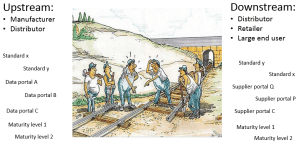 Another concept, which is the opposite, is also emerging. This is manufacturers and upstream distributors establishing PIM customer portals, where suppliers can fetch product information. This concept is in my eyes flawed exactly the opposite way.
 Now, the focal point of Product Data Lake is not the exciting world of address data quality, but product data quality.


 The fear, and actual observations made, is that that a data lake will become a data dump. No one knows what is in there, where it came from, who is going to clean up the mess and eventually have a grip on how it should be handled in the future – if there is a future for the data lake concept.
 This resonates very well with my findings. Very low practical this means that you will not win by translating all product descriptions into English. Even the metadata has to be multilingual, as you will interact with trading partners using different languages. While one public standard for product information may be king in one region, this will most likely not be the case in another region, which again effects how you collaborate with trading partners in different geographies.
 I imagine that handling product information must be a big pain point at the Santa Corporation. All the product information from suppliers of present items comes in using different standards and various languages. In the same way the wish lists from boys and girls comes in many languages and using many different wordings.
 From what I have experienced, the concept of a supplier data portal for product data has limited chances of success. The problem for you as retailer or other form of downstream trading partner is your supplier. They will eventually have to deal with hundreds of supplier portals with different format and structure by the choice of their downstream trading partners, whereof you are just one. If you are a big one to them, it might work. Else probably not.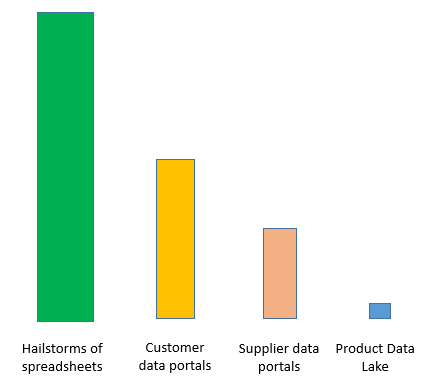
 Liliendahl on Data Quality