3 out of 10

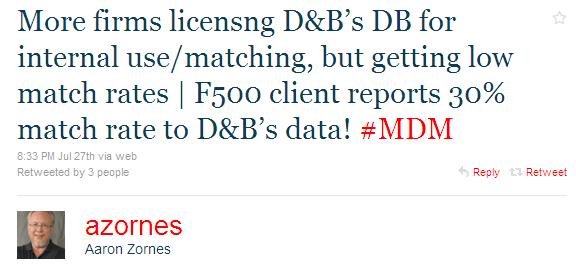
Just before I left for summer vacation I noticed a tweet by MDM guru Aaron Zornes saying:

This is a subject very close to me as I have worked a lot with business directory matching during the last 15 years not at least matching with the D&B WorldBase.

The problem is that if you match your B2B customers, suppliers and other business partners with a business directory like the D&B WorldBase you could naively expect a 100% match.

If your result is only a 30% hit rate the question is: How many among the remaining 70% are false negatives and how many are true negatives.

True negatives

There may be a lot of reasons for true negatives, namely:

  • Your business entity isn’t listed in the business directory. Some countries like those of the old Czechoslovakia, some English speaking countries in the Pacifics, the Nordic countries and others have a tight public registration of companies and then it is less tight from countries in North America, other European countries and the rest of the world.
  • Your supposed business entity isn’t a business entity. Many B2B customer/prospect tables holds a lot of entities not being a formal business entity but being a lot of other types of party master data.
  • Uniqueness may be different defined in the business directory and your table to be matched. This includes the perception of hierarchies of legal entities and branches – not at least governmental and local authority bodies is a fuzzy crowd. Also the different roles as those of small business owners are a challenge. The same is true about roles as franchise takers and the use of trading styles.

False negatives

In business directory matching the false negatives are those records that should have been matched by an automated function, but isn’t.

The number of false negatives is a measure of the effectiveness of the automated matching tool(s) and rules applied. Big companies often use the magic quadrant leaders in data quality tools, but these aren’t necessary the best tools for business directory matching.

Personally I have found that you need a very complex mix of tools and rules for getting a decent match rate in business directory matching, including combining both deterministic and probabilistic matching. Some different techniques are explained in more details here.

Bookmark and Share

Business Directory Musings

This coming Sunday I have worked professionally within Information Technology for 30 years. As I will be on a (well deserved!) vacation in Andalusia on Sunday, I’ll better post my thoughts today.

I have had a lot of different positions and worked in a lot of different domains. The single subject I have worked with the most is business directories.

My first job was at the Danish Tax Authorities and one of the assignments was being a secretary to the committee working for a joint registration of companies in Denmark. Besides I learned a lot about working in political driven organizations and about aligning business and technology I feel good about having been part of the start of building a public sector master data directory. Such directories are both essential for an effective public administration and can be used as external reference data in private enterprises as a valuable mean to improve data quality with business partner master data.

Later I have been working a lot with improving data quality through matching solutions around business directories. This goes from the Dun & Bradstreet WorldBase holding nearly 170 million business entities from all over the world, over databases like the EuroContactPool to national databases either holding all businesses (available) in a single country or given industry segments.

I guess I also will be spending some additional years from now with integrating business directory information into business processes as smooth as possible and preferable along with a range of other kind of external reference data.

One of the new sources building up in the cloud in the realm of business directories is master data references in social networks. The LinkedIn Companies feature is a prominent example. Of course such directories have some data quality issues. This is seen in looking at the companies where I currently work:

  • DM Partner A/S seems OK
  • Omikron Data Quality has 90 employees according to the company profile (filled out by yours truly). Then it’s strange that there are only 25 profiles in the network. But that’s because most employees are in Germany where the competing network called Xing is stronger.
  • Trapeze Group Europe has not been updated with a recent merger and not all profiles has changed their profile accordingly yet. But I’m sure that will be done as time goes by.

I have no doubt though that including information from social networks will become a part of integrating business partner master data in my future.

Bookmark and Share

Social Master Data Management

The term ”Social CRM” has been around for a while. Like traditional CRM (Customer Relationship Management) is heavily dependent on proper MDM (Master Data Management) we will also see that enterprise wide social CRM will be dependent on a proper social MDM element in order to be a success.

The challenge in social MDM will be that we are not going to replace some data sources for MDM, but we are actually going to add some more sources and handle the integration of these sources with the sources for traditional CRM and MDM and other new sources coming from the cloud.

Customer Master Data sources will expand to embrace:

  • Traditional data entry from field work like a sales representative entering prospect and customer master data as part of Sales Force Automation.
  • Data feed and data integration with external reference data like using a business directory. Such integration will increasingly take place in the cloud and the trend of governments releasing public sector data will add tremendously to this activity.
  • Self registration by prospects and customers via webforms.
  • Social media master data captured during social CRM and probably harvested in more and more structured ways.

Social media master data are found as profiles in services as Facebook mainly for business-to–consumer activities, LinkedIn mainly for business-to-business activities and Twitter somewhere in between. These are only some prominent examples of such services. Where LinkedIn may be dominant for professional use in English speaking countries and countries where English is widely spoken as Scandinavia and the Netherlands other regions are far less penetrated by LinkedIn. For example for German speaking countries the similar network service called Xing is much more crowded. So, when embracing global business you will have to acknowledge the diversity found in social network services.

A good way to integrate all these sources in business processes is using mashup’s. An example will be a mashup for entering customer data. If you are entering a business entity you may want to know:

  • What is already known in internal databases about that entity – either via a centralized MDM hub or throughout disparate databases?
  • Is the visit address correct according to public sector data?
  • How is the business account related to other business entities learned from a business directory?
  • Do we recognize the business contact in social networks – maybe we did have contact before in another relation?

If you are entering a consumer entity you may want to know:

  • Does that person already exist in our internal databases – as an individual and as a household?
  • What do we know about the residence address from public sector data?
  • Can we obtain additional data from phone book directories, nixie lists and what else being available, affordable and legal in the country in question?
  • How do we connect in social media?

Of course privacy is a big issue. Norms vary between countries, so do the legal rules. Norms vary between individuals and by the individuals as a private person and a business contact. Norms vary between industries and from company to company.

If aligning people, processes and technology didn’t matter before, it will when dealing with social master data management.

Bookmark and Share

Data Quality is an Ingredient, not an Entrée

Fortunately it is more and more recognized that you don’t get success with Business Intelligence, Customer Relationship Management, Master Data Management, Service Oriented Architecture and many more disciplines without starting with improving your data quality.

But it will be a big mistake to see Data Quality improvement as an entrée before the main course being BI, CRM, MDM, SOA or whatever is on the menu. You have to have ongoing prevention against having your data polluted again over time.

Improving and maintaining data quality involves people, processes and technology. Now, I am not neglecting the people and process side, but as my expertise is in the technology part I will like to mention some the technological ingredients that help with keeping data quality at a tasty level in your IT implementations.

Mashups

Many data quality flaws are (not surprisingly) introduced at data entry. Enterprise data mashups with external reference data may help during data entry, like:

  • An address may be suggested from an external source.
  • A business entity may be picked from an external business directory.
  • Various rules exist in different countries for using consumer/citizen directories – why not use the best available where you do business.

External ID’s

Getting the right data entry at the root is important and it is agreed by most (if not all) data quality professionals that this is a superior approach opposite to doing cleansing operations downstream.

The problem hence is that most data erodes as time is passing. What was right at the time of capture will at some point in time not be right anymore.

Therefore data entry ideally must not only be a snapshot of correct information but should also include raw data elements that make the data easily maintainable.

Error tolerant search

A common workflow when in-house personnel are entering new customers, suppliers, purchased products and other master data are, that first you search the database for a match. If the entity is not found, you create a new entity. When the search fails to find an actual match we have a classic and frequent cause for introducing duplicates.

An error tolerant search are able to find matches despite of spelling differences, alternative arranged words, various concatenations and many other challenges we face when searching for names, addresses and descriptions.

Bookmark and Share

Location, Location, Location

Now, I am not going to write about the importance of location when selling real estates, but I am going to provide three examples about knowing about the location when you are doing data matching like trying to find duplicates in names and addresses.

Location uniqueness

Let’s say we have these two records:

  • Stefani Germanotta, Main Street, Anytown
  • Stefani Germanotta, Main Street, Anytown

The data is character by character exactly the same. But:

  • There is only a very high probability that it is the same real world individual if there is only one address on Main Street in Anytown.
  • If there are only a few addresses on Main Street in Anytown, you will still have a fair probability that this is the same individual.
  • But if there are hundreds of addresses on Main Street in Anytown, the probability that this is the same individual will be below threshold for many matching purposes.

Of course, if you are sending a direct marketing letter it is pointless sending both letters, as:

  • Either they will be delivered in the same mailbox.
  • Or both will be returned by postal service.

So this example highlights a major point in data quality. If you are matching for a single purpose of use like direct marketing you may apply simple processing. But if you are matching for multiple purposes of use like building a master data hub, you don’t avoid some kind of complexity.

Location enrichment

Let’s say we have these two records:

  • Alejandro Germanotta, 123 Main Street, Anytown
  • Alejandro Germanotta, 123 Main Street, Anytown

If you know that 123 Main Street in Anytown is a single family house there is a high probability that this is the same real world individual.

But if you know that 123 Main Street in Anytown is a building used as a nursing home, a campus or that this entrance has many apartments or other kind of units, then it is not so certain that these records represents the same real world individual (not at least if the name is John Smith).

So this example highlights the importance of using external reference data in data matching.

Location geocoding

Let’s say we have these two records:

  • Gaga Real Estate, 1 Main Street, Anytown
  • L.  Gaga Real Estate, Central Square, Anytown

If you match using the street address, the match is not that close.

But if you assigned a geocode for the two addresses, then the two addresses may be very close (just around the corner) and your match will then be pretty confident.

Assigning geocodes usually serve other purposes than data matching. So this example highlights how enhancing your data may have several positive impacts.

Bookmark and Share

What’s In a Given Name?

I use the term ”given name” here for the part of a person name that in most western cultures is called a ”first name”.

When working with automation of data quality, master data management and data matching you will encounter a lot of situations where you will like to mimic what we humans do, when we look at a given name.  And when you have done this a few times you also learn the risks of doing so.

Here is some of the learning I have been through:

Gender

Most given names are either for males or for females. So most times you instinctively know if it is a male or a female when you look at a name. Probably you also know those given names in your culture that may be both. What often creates havoc is when you apply rules of one culture to data coming from a different culture.  The subject was discussed on DataQualityPro here.

Salutation

In some cultures salutation is paramount – not at least in Germany. A correct salutation may depend on knowing the gender. The gender may be derived from the given name. But you should not use the given name itself in your greeting.

So writing to “Angela Merkel” will be “Sehr geehrte Frau Merkel” – translates to “Very honored Mrs. Merkel”.

If you have a small mistake as the name being “Angelo Merkel”, this will create a big mistake when writing “Sehr geehrter Herr Merkel” (Very honored Mr. Merkel) to her.

Age

In a recent post on the DataFlux Community of Experts Jim Harris wrote about how he received tons of direct mails assuming he was retired based on where he lives.

I have worked a bit with market segmentation and data (information) quality. I don’t know how it is with first names in the United States, but in Denmark you may have a good probability with estimating an age based on your given name. The statistical bureau provides statistics for each name and birth year. So combining that with the location based demographic you will get a better response rate in direct marketing.

Nicknames

Nicknames are used very different in various cultures. In Denmark we don’t use them that much and definitely very seldom in business transactions. If you meet a Dane called Jim his name is actually Jim. If you have a clever piece of software correcting/standardizing the name to be James, well, that’s not very clever.


Bookmark and Share

Real World Alignment

I am currently involved in a data management program dealing with multi-entity (multi-domain) master data management described here.

Besides covering several different data domains as business partners, products, locations and timetables the data also serves multiple purposes of use. The client is within public transit so the subject areas are called terms as production planning (scheduling), operation monitoring, fare collection and use of service.

A key principle is that the same data should only be stored once, but in a way that makes it serve as high quality information in the different contexts. Doing that is often balancing between the two ways data may be of high quality:

  • Either they are fit for their intended uses
  • Or they correctly represent the real-world construct to which they refer

Some of the balancing has been:

Customer Identification

For some intended uses you don’t have to know the precise identity of a passenger. For some other intended uses you must know the identity. The latter cases at my client include giving discounts based on age and transport need like when attending educational activity. Also when fighting fraud it helps knowing the identity. So the data governance policy (and a business rule) is that customers for most products must provide a national identification number.

Like it or not: Having the ID makes a lot of things easier. Uniqueness isn’t a big challenge like in many other master data programs. It is also a straight forward process when you like to enrich your data. An example here is accurately geocoding where your customer live, which is rather essential when you provide transportation services.

What geocode?

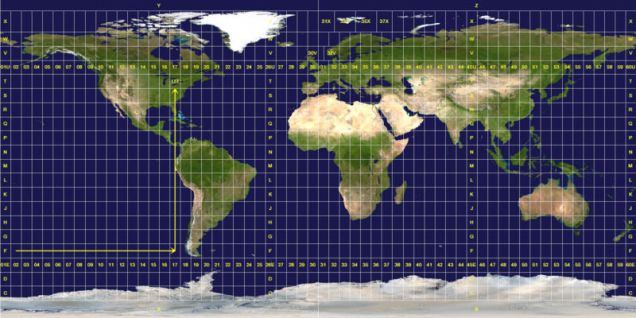
You may use a range of different coordinate systems to express a position as explained here on Wikipedia. Some systems refers to a round globe (and yes, the real world, the earth, is round), but it is a lot easier to use a system like the one called UTM where you easily may calculate the distance between two points directly in meters assuming the real world is as flat as your computer screen.


Bookmark and Share

Relational Data Quality

Most of the work related to data quality improvement I do is done with data in relational databases and is aimed at creating new relations between data. Examples (from party master data) are:

  • Make a relation between a postal address in a customer table and a real world address (represented in an official address dictionary).
  • Make a relation between a business entity in a vendor table and a real world business (represented in a business directory most often derived from an official business register).
  • Make a relation between a consumer in one prospect table and a consumer in another prospect table because they are considered to represent the same real world person.

When striving for multi-purpose data quality it is often necessary to reflect further relations from the real world like:

  • Make a relation in a database reflecting that two (or more) persons belongs to the same household (on the same real world address)
  • Make a relation in the database reflecting that two (or more) companies have the same (ultimate) mother.

Having these relations done right is fundamental for any further data quality improvement endeavors and all the exciting business intelligence stuff. In doing that you may continue to have more or less fruitful discussions on say the classic question: What is a customer?

But in my eyes, in relation to data quality, it doesn’t matter if that discussion ends with that a given row in your database is a customer, an old customer, a prospect or something else. Building the relations may even help you realize what that someone really is. Could be a sporadic lead is recognized as belonging to the same household as a good customer. Could be a vendor is recognized as being a daughter company of a hot prospect. Could be someone is recognized as being fake. And you may even have some business intelligence that based on the relations may report a given row as a customer role in one context and another role in another context.

Big Time ROI in Identity Resolution

Yesterday I had the chance to make a preliminary assessment of the data quality in one of the local databases holding information about entities involved in carbon trade activities. It is believed that up to 90 percent of the market activity may have been fraudulent with criminals pocketing 5 billion Euros. There is a description of the scam here from telegraph.co.uk.

Most of my work with data matching is aimed at finding duplicates. In doing this you must avoid finding so called false positives, so you don’t end up merging information about to different real world entities. But when doing identity resolution for several reasons including preventing fraud and scam you may be interested in finding connections between entities that are not supposed to be connected at all.

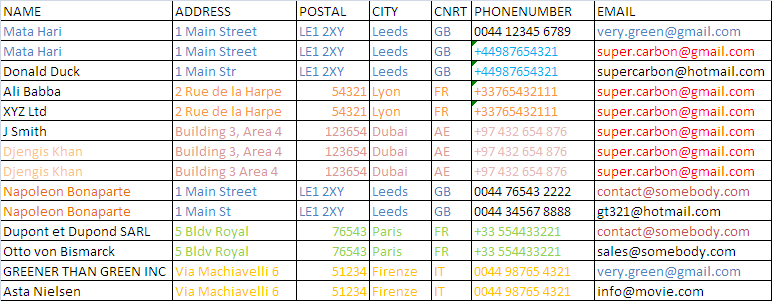
The result from making such connections in the carbon trade database was quite astonishing. Here is an example where I have changed the names, addresses, e-mails and phones, but such a pattern was found in several cases:

Here we have an example of a group of entities where the name, address, e-mail or phone is shared in a way that doesn’t seem natural.

My involvement in the carbon trade scam was initiated by a blog post yesterday by my colleague Jan Erik Ingvaldsen based on the story that journalists by merely gazing the database had found addresses that simply doesn’t exist.

So the question is if authorities may have avoided losing 5 billion taxpayer Euros if some identity resolution including automated fuzzy connection checks and real world checks was implemented. I know that you are so much more enlightened on what could have been done when the scam is discovered, but I actually think that there may be a lot of other billions of Euros (Pounds, Dollars, Rupees) to avoid losing out there by making some decent identity resolution.

Bookmark and Share