Annus Horribilis 2020, Annus Mirabilis 2021?

At this time of the year, it is custom to make a foreseeing about what will happen next year usually within a specific area – as for example data management.

After 2020 one should think that making any qualified guess about next year should be regarded within a huge amount of uncertainty.

Well, let us have a go anyway.

The horrible year of the outbreak of the pandemic has also affected the data management scene. One often mentioned theme is the accelerated digitalization, which all the bad things about the pandemic aside, seen in isolation (so to speak), is a positive development.

Digitalization also push globalization. Now you do not have to work with data management partners who is within a 5 miles reach – 5,000 kilometres will be the same.

In fact, the outlook for the data management industry is not bad at all. Digital transformation initiatives will require investments in data management consultancy, data management services and data management technology. The competition will intensify with many partners available at a global range. This will be an opportunity for smaller consultancies with broad visions, nimble service providers with scalable offerings and forward-looking tool vendors with doable solutions.

The chances for gaining market shares in a developing market are good for those of you who sell data management stuff.

The chances for getting the best help are good for those of you who buy data management stuff.

A Merry Christmas to you who celebrate this and a Happy Calendar New Year to all of you.    
What is Contextual MDM?

The term “contextual Master Data Management” has been floating around in a couple of years as for example when tool vendors want to emphasize on a speciality that they are very good at. One example is from the Data Quality Management leader Precisely in the August 2020 article with the title How Contextual MDM Drives True Results in the Age of Data Democratization. Another example is from the Product Information/Experience Management leader Contentserv in the 2017 article with the title Contentserv Expands its Portfolio with Innovative Contextual MDM.

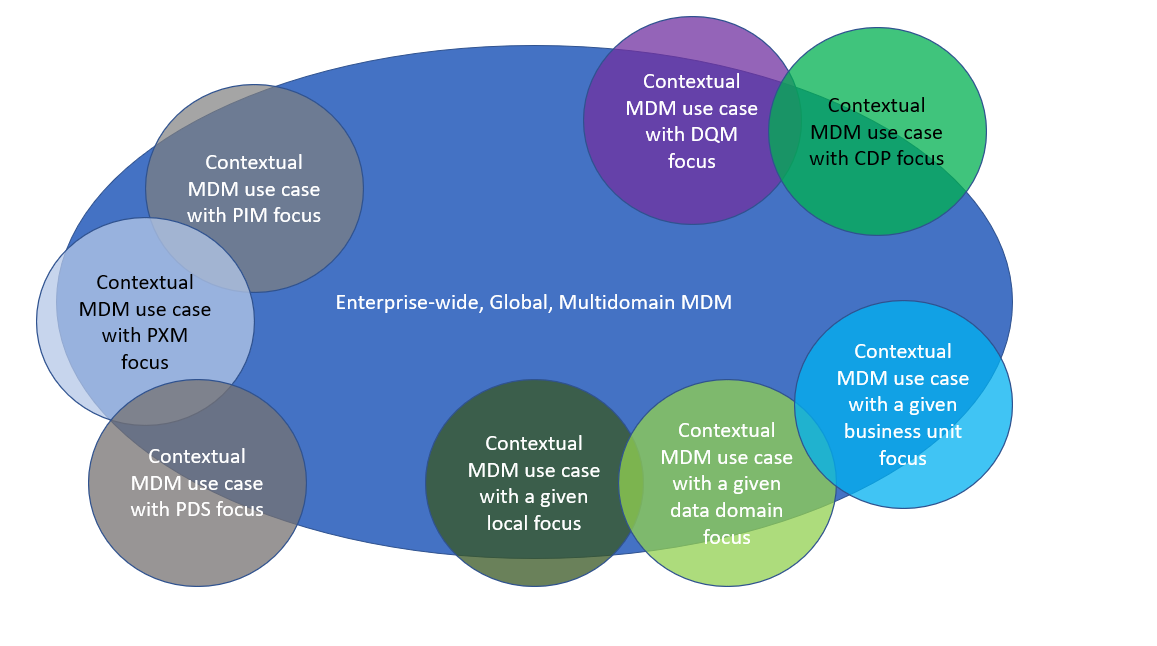
We can see contextual MDM as smaller pieces of MDM with a given flavour as for example focussing on sub/overlapping disciplines as:

The focus can also be at:

  • A given locality
  • A given master data domain as customer, supplier, employee, other/all party, product (beyond PIM), location or asset
  • A given business unit

You must eat an elephant one bite at a time. Therefore, contextual MDM makes a good concept for getting achievable wins.   

However, in an organization with high level of data management maturity the range of contextual MDM use cases, and the solutions for them, will be encompassed by a common enterprise-wide, global, multidomain MDM framework – either as one solution or a well-orchestrated set of solutions.

One example with dependencies is when working with personalization as part of Product Experience Management (PXM). Here you need customer personas. The elephant in the room, so to speak, is that you have to get the actual personas from Customer MDM and/or the Customer Data Platform (CDP).

In having that common MDM solution/framework there are some challenges to be solved in order to cater for all the contextual MDM use cases. One such challenge, being context-aware customer views, was touched upon in the post There is No Single Customer 360 View.

The Start of the History of Data and Information Quality Management

I am sad to hear that Larry English has passed away as I learned from this LinkedIn update by C. Lwanga Yonke.

As said in here: “When the story of Information Quality Management is written, the first sentence of the first paragraph will include the name Larry English”.

Larry pioneered the data quality – or information quality as he preferred to coin it – discipline.

He was an inspiration to many data and information quality practitioners back in the 90’s and 00’s, including me, and he paved the way for bringing this topic to the level of awareness that it has today.

In his teaching Larry emphasized on the simple but powerful concepts which are the foundation of data quality and information quality methodologies:

  • Quantify the costs and lost opportunities of bad information quality
  • Always look for the root cause of bad information quality
  • Observe the plan-do-check-act circle when solving the information quality issues

Let us roll up our sleeves and continue what Larry started.

There is No Single Customer 360 View

The terms “Single Customer View” (SCV) and “360 View of Customer” have been commonly used within the field of Master Data Management (MDM) since things started with the very first Customer Data Integration (CDI) solutions.

The theory is simple: A customer MDM solution creates golden records that uniquely identify any person or business who is a customer of your organization.  The solution then builds out a complete description of those persons and businesses which serves as the single source of truth.

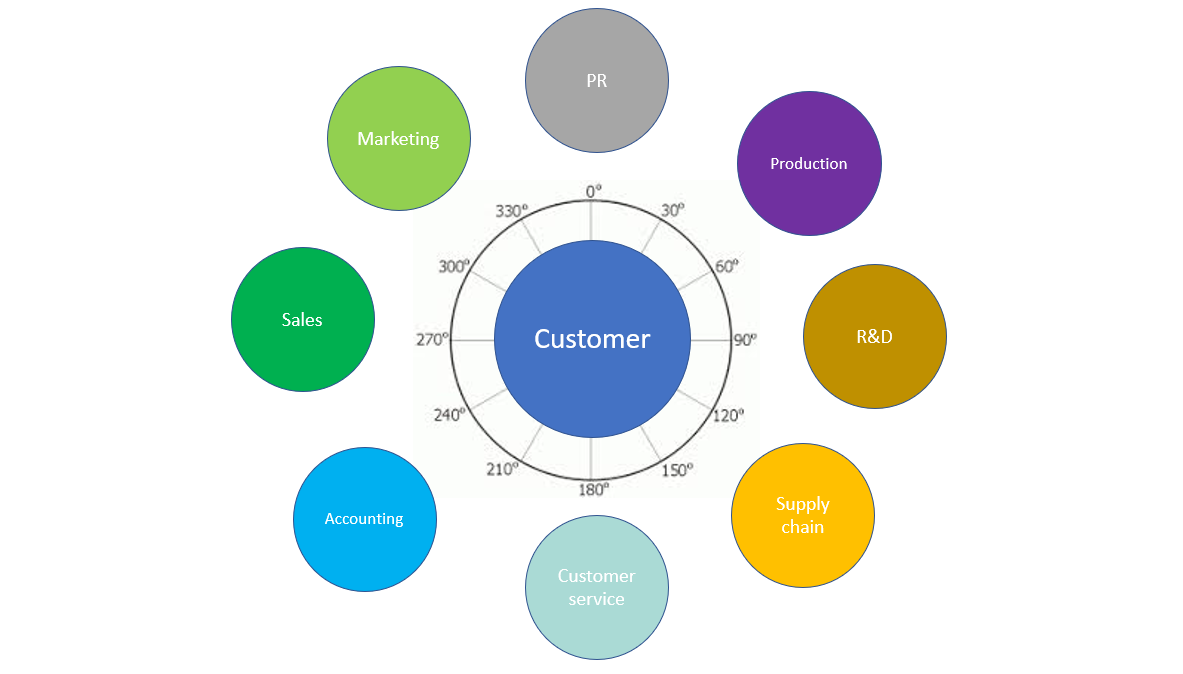
In practice, this is very hard.  Compiling a concept for a view that suits all scenarios across all business units is often too daunting; the challenges involved in this effort often kill off the customer MDM implementation before completion. This is sad, because it is also hard to succeed in digital transformation and launch new digital services when you have unconnected customer views scattered across the application landscape within your organization.

Therefore, building context-aware customer views is a very useful concept when you want to deliver successful customer MDM implementations and digital transformation projects.    

Learn more about this in the white paper co-authored by Reltio and yours truly: Taking Customer 360 to The Next Level: Fueling New Digital Business