Doctor Livingstone, I Presume?

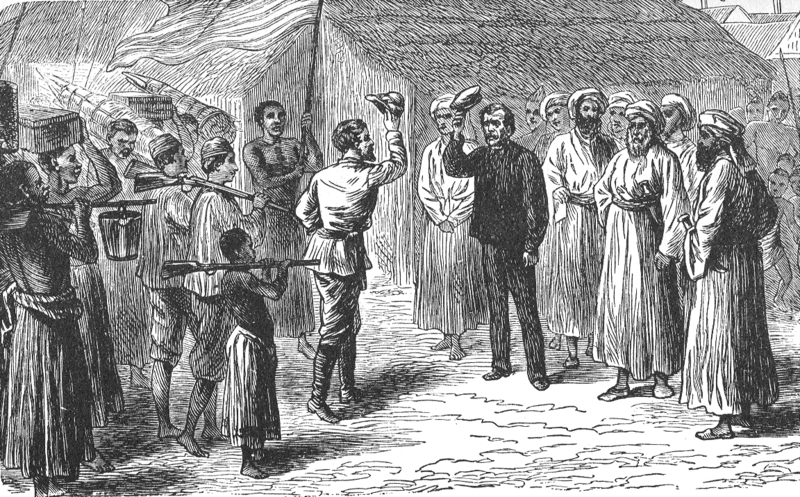
The title of this blog post is a famous quote from history (which as most quotes are disputed) said by Henry Morton Stanley (who actually was born John Rowlands) when he found Doctor Livingstone (David Livingstone) deep into the African jungle in 1871 after a 6 month expedition with 200 men through unknown territory.
Today it’s much easier to find people. Mobile phone use, credit card transactions and tweet positions leads the way, unless of course you really, really don’t want to be found as it was with Osama bin Mohammed bin Awad bin Laden.

One of the biggest issues in data quality is real world alignment of the data registered about persons. As told in the post out Out of Africa there are some issues in the way we handle such data, as:

  • Cultural diversity: Names, addresses, national ID’s and other basic attributes are formatted differently country by country and in some degree within countries. Most data models with a person entity are build on the format(s) of the country where it is designed.
  • Intended purpose of use: Person master data are often stored in tables made for specific purposes like a customer table, a subscriber table a contact table and so on. Therefore the data identifying the individual is directly linked with attributes describing a specific role of that individual.
  • “Impersonal” use: Person data is often stored in the same table as other party master types as business entities, projects, households et cetera.

Besides that I have found that many organizations don’t use the sources available today in getting data quality right when it comes to contact data.

It’s not that I suggest actually hacking into mobile phone use logs and so. There are a lot of sources not compromising with privacy that let you exploit external reference data as explained in the post Beyond Address Validation.


Bookmark and Share

Fake, Snoopy, Kitty and Duplicate Social Media Profiles

As a data quality practitioner I have never been in doubt that when it is said that FaceBook has 900 million profiles, that doesn’t mean that 900 million people have a Facebook profile.

Some people have more than one profile. Some people who had a profile are not among us anymore. As reported by BBC in the article Facebook ‘likes’ and adverts’ value doubted, some profiles are fake resulting in FaceBook earning real money that should have been fake money.

Even some profiles are not really fake but serves other purposes like a snoopbook account created to reveal fraud.

And then some profiles belongs to (the owners of) real cats, as reported by James Standen in a comment to my post called Out of Facebook.

On another social media platform, Twitter, I am guilty of having 5 profiles. Besides my real account hlsdk I have created hldsk, hsldk and hlsdq, so I have been able to thank people mentioning me with a wrong spelled handle. And then there is my female side: MissDqPiggy.

Bookmark and Share

Staying in Doggerland

Currently I’m travelling a lot between my present home in London, United Kingdom and Copenhagen, Denmark where I have most of my family and where the iDQ headquarter is.

When flying between London and Copenhagen you pass the southern North Sea. In the old days (8,000 years ago) this area was a land occupied by human beings. This ancient land is known today as Doggerland.

Sometimes I feel like a citizen of Doggerland not really belonging in the United Kingdom or Denmark.

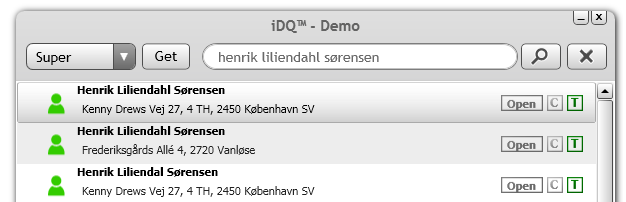
I still have some phone subscriptions in Denmark I use there and my family are using there.  The phone company seems to have a hard time getting a 360 degree customer view as I have two different spellings of my name and two different addresses as seen on the screen when I look up myself in the iDQ service:

Besides having a Customer Relationship Mess (CRM) the phone company has recently shifted their outsourcing partner (from CSC to TCS). This has caused a lot of additional mess, apparently also closing one of my subscriptions due to that they have failed to register my payments. They did however send a chaser they say, but to the oldest of the addresses where I don’t pick up mail anymore.

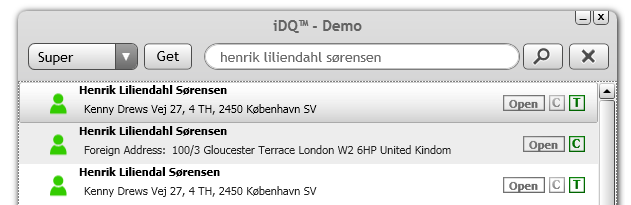
I called to settle the matter and asked if they could correct the address not in use anymore. They couldn’t. The operator did some kind of query into the citizen hub similar to what I can do on iDQ:

However the customer service guy’s screen just showed that I have no address in Denmark in the citizen hub (called CPR), so he couldn’t change the address.

Apparently the phone company have correctly picked up an accurate address in the citizen hub when I got the subscription but failed to update it (along with the other subscriptions) when I moved to another domestic address and now don’t have an adequate business rule when I’m registered at a foreign address.

So now I’m staying in Doggerland.

Bookmark and Share

Beyond Address Validation

The quality of contact master data is the number one data quality issue around.

Lately there has been a lot of momentum among data quality tool providers in offering services for getting at least the postal address in contact data right. The new services are improved by:

  • Being cloud based offering validation services that are implemented at data entry and based on fresh reference data.
  • Being international and thus providing address validation for customer and other party data embracing a globalized world.

Capturing an address that is aligned with the real world may have a significant effect on business outcomes as reported by the tool vendor WorldAddresses in a recent blog post.

However, a valid address based on address reference data only tells you if the address is valid, not if the addressee is (still) on the address, and you are not sure if the name and other master data elements are accurate and complete. Therefore you often need to combine address reference data with other big reference data sources as business directories and consumer/citizen reference sources.

Using business directories is not new at all. Big reference sources as the D&B WorldBase and many other directories have been around for many years and been a core element in many data quality initiatives with customer data in business-to-business (B2B) environments and with supplier master data.

Combining address reference data and business entity reference data makes things even better, also because business directories doesn’t always come with a valid address.

Using public available reference data when registering private consumers, employees and other citizen roles has until now been practiced in some industries and for special reasons. Therefore the big reference data and the services are out there and being used today in some business processes.

Mashing up address reference data, business entity reference data and consumer/citizen reference data is a big opportunity for many organizations in the quest for high quality contact master data, as most organizations actually interact with both companies and private persons if we look at the total mix of business processes.

The next big source is going to be exploiting social network profiles as well. As told in the post Social Master Data Management social media will be an additional source of knowledge about our business partners. Again, you won’t find the full truth here either. You have to mashup all the sources.

Bookmark and Share

Sometimes Big Brother is Confused

Google Maps knows a lot. It knows about addresses and it knows about companies on these addresses.

As with most services it seems that Google Maps gets the reference data from different sources.

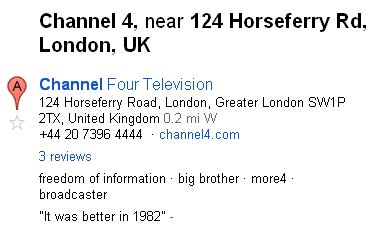
The other day I went to visit “Channel 4”, the British TV channel that hosted the UK “Big Brother” reality show until lately.

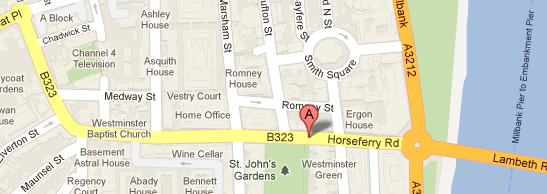
I typed in the address “124 Horseferry Road, London, United Kingdom” and got the point:

However, it seems that there is a large building up to the left called “Channel 4 Television”. Strange. Then I tried with “Channel 4, 124 Horseferry Road, London, United Kingdom”:

Oh, so I will find “Channel Four Television, 124 Horseferry Road” in the “Channel 4 Television” building only 0.2 miles west of “124 Horseferry Rd”:

Bookmark and Share

Instant Data Enrichment

Data enrichment is one of the core activities within data quality improvement. Data enrichment is about updating your data in order to be more real world aligned by correcting and completing with data from external reference data sources.

Traditionally data enrichment has been a follow up activity to data matching and doing data matching as a prerequisite for data enrichment has been a good part of my data quality endeavor during the recent 15 years as reported in the post The GlobalMatchBox.

During the last couple of years I have tried to be part of the quest for doing something about poor data quality by moving the activities upstream. Upstream data quality prevention is better than downstream data cleansing wherever applicable. Doing the data enrichment at data capture is the fast track to improve data quality for example by avoiding contact data entry flaws.

It’s not that you have to enrich with all the possible data available from external sources at once. What is the most important thing is that you are able to link back to external sources without having to do (too much) fuzzy data matching later. Some examples:

  • Getting a standardized address at contact data entry makes it possible for you to easily link to sources with geo codes, property information and other location data at a later point.
  • Obtaining a company registration number or other legal entity identifier (LEI) at data entry makes it possible to enrich with a wealth of available data held in public and commercial sources.
  • Having a person’s name spelled according to available sources for the country in question helps a lot when you later have to match with other sources.

In that way your data will be fit for current and future multiple purposes.

Bookmark and Share

255 Reasons for Data Quality Diversity

255 is one source of truth about how many countries we have on this planet. Even with this modest list of reference data there are several sources of the truth. Another list may have 262 entries and a third list 240 entries.

As I have made a blog post some years ago called 55 reasons to improve data quality I think 255 fits nice in the title of this post.

The 55 reasons to improve data quality in the former post revolves around name and address uniqueness. In the quest for having uniqueness, and fulfilling other data quality dimensions as completeness and timeliness, a have often advocated for using deep (or big) reference data sources as address directories, business directories and consumer/citizen directories.

Doing so in the best of breed way involves dealing with a huge number of reference data sources. Services claimed to have worldwide coverage often falls a bit short compared to local services using local reference sources.

For example when I lived in Denmark, at tiny place in one corner of the world, I was often amazed how address correction services from abroad only had (sometimes outdated) street level coverage, while local reference data sources provides building number and even suite level validation.

Another example was discussed in the post The Art in Data Matching where the multi-lingual capacities needed to do well in Belgium was stressed in the comments.

Every country has its own special requirement for getting name and address data quality right, the data quality dimensions for reference data are different and governments has found 255 (or so) different solutions to balancing privacy and administrative effectiveness.

Right now I’m working on internationalization and internationalisation of a data and software service called instant Data Quality. This service makes big reference data from all over the world available in a single mashup. For that we need at least 255 partners.

Bookmark and Share

At Least Two Versions of the Truth

Precisely one year ago I wrote a post called Single Company View examining the challenges of getting a single business partner view in business-to-business (B2B) party master data.

Yesterday Robert Hawker of Vodafone made a keynote at the MDM Summit Europe 2012 telling about supplier master data management.

One of the points was that sometimes you really want the exactly same real world entity to be two golden records in your master data hub, as there may be totally different business activities made with the same legal entity. The Vodafone example was:

  • Having an antenna placed on the top of a building owned by a certain company and thus paying a fee for that
  • Buying consultancy services from the same company

I have met such examples many times when doing data matching as told in the post Entity Revolution vs Entity Evolution.

However at one occasion, many years ago, I worked in a company where not having a single business partner view nearly became a small disaster.

Our company delivered software for membership administration and was at the same time a member of an employer organisation that also happened to be a customer.

A new director got the brilliant idea, that cancelling the membership of the employer organization was an obvious cost reduction.

The cancellation was sent. The employer organisation confirmed the cancellation adding, that they were very sorry that internal business rules at the same time forced them to not being a customer anymore.

Cancellation was cancelled of course and damage control was initiated.

Bookmark and Share

The Taxman: Data Quality’s Best Friend

Collection of taxes has always been a main driver for having registries and means of identifying people, companies and properties.

5,000 years ago the Egyptians made the first known census in order to effectively collect taxes.

As reported on the Data Value Talk blog, the Netherlands have had 200 years of family names thanks to Napoleon and the higher cause of collecting taxes.

Today the taxman goes cross boarder and wants to help with international data quality as examined in the post Know Your Foreign Customer. The US FATCA regulation is about collecting taxes from activities abroad and as said on the Trillium blog: Data Quality is The Core Enabler for FATCA Compliance.

My guess is that this is only the beginning of a tax based opportunity for having better data quality in relation to international data.

In a tax agenda for the European Union it is said: “As more citizens and companies today work and operate across the EU’s borders, cooperation on taxation has become increasingly important.”.

The EU has a program called FISCALIS in the making. Soon we not only have to identify Americans doing something abroad but practically everyone taking part in the globalization.

For that we all need comprehensive accessibility to the wealth of global reference data through “cutting-edge IT systems” (a FISCALIS choice of wording).

I am working on that right now:

Bookmark and Share

Big Reference Data Musings

The term “big data” is huge these days. As Steve Sarsfield suggest in a blog post yesterday called Big Data Hype is an Opportunity for Data Management Pros, well, let’s ride on the wave (or is it tsunami?).

The definition of “big data” is as with many buzzwords not crystal clear as examined in a post called It’s time for a new definition of big data on Mike2.0 by Robert Hillard. The post suggests that big may be about volume, but is actually more about big complexity.

As I have worked intensively with large amounts of rich reference data, I have a homemade term called “big reference data”.

Big Reference Data Sets

Reference Data is a term often used either instead of Master Data or as related to Master Data. Reference data is those data defined and (initially) maintained outside a single organization. Examples from the party master data realm are a country list, a list of states in a given country or postal code tables for countries around the world.

The trend is that organizations seek to benefit from having reference data in more depth than those often modest populated lists mentioned above.

An example of a big reference data set is the Dun & Bradstreet WorldBase. This reference data set holds around 300 different attributes describing over 200 million business entities from all over world.

This data set is at first glance well structured with a single (flat) data model for all countries. However, when you work with it you learn that the actual data is very different depending on the different original sources for each country. For example addresses from some countries are standardized, while this isn’t the case for other countries. Completeness and other data quality dimensions vary a lot too.

Another example of a large reference data set is the United Kingdom electoral roll that is mentioned in the post Inaccurately Accurate. As told in the post there are fit for purpose data quality issues. The data set is pretty big, not at least if you span several years, as there is a distinct roll for every year.

Big Reference Data Mashup

Complexity, and opportunity, also arises when you relate several big reference data sets.

Lately DataQualityPro had an interview called What is AddressBase® and how will it improve address data quality? Here Paul Malyon of Experian QAS explains about a new combined address reference source for the United Kingdom.

Now, let’s mash up the AddressBase, the WorldBase and the Electoral Rolls – and all the likes.

Image called Castle in the Sky found on photobotos.

Bookmark and Share