Business Contact Reference Data

When working with selling data quality software tools and services I have often used external sources for business contact data and not at least when working with data matching and party master data management implementations in business-to-business (B2B) environments I have seen uploads of these data in CRM sources.

A typical external source for B2B contact data will look like this:
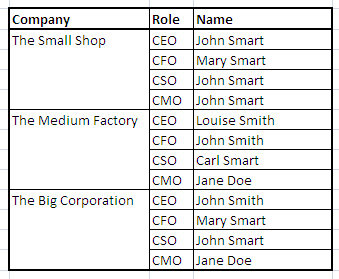
Some of the issues with such data are:

  • Some of the contact data names may be the same real world individual as told in the post Echoes in the Database
  • People change jobs all the time. The external lists will typically have entries verified some time ago and when you upload to your own databases, data will quickly become useless do to data decay.
  • When working with large companies in customer and other business partner roles you often won’t interact with the top level people, but people in lower levels not reflected in such external sources.

The rise of social networks has presented new opportunities for overcoming these challenges as examined in a post (written some years ago) called Who is working where doing what?

However, I haven’t seen so many attempts yet to automate and include working with social network profiles in business processes. Surely there are technical issues and not at least privacy considerations in doing so as discussed in the post Sharing Social Master Data.

Right now we have a discussion going on in the LinkedIn Social MDM group about examples of connecting social network profiles and master data management. Please add your experiences in the group here – and join if you aren’t already a member.


Bookmark and Share

Avoiding Contact Data Entry Flaws

Contact data is the data domain most often mentioned when talking about data quality. Names and addresses and other identification data are constantly spelled wrong, or just different, by the employees responsible of entering party master data.

Cleansing data long time after it has been captured is a common way of dealing with this huge problem. However, preventing typos, wrong hearings and multi-cultural misunderstandings at data entry is a much better option wherever applicable.

I have worked with two different approaches to ensure the best data quality for contact data entered by employees. These approaches are:

  • Correction and
  • Assistance

Correction

With correction the data entry clerk, sales representative, customer service professional or whoever is entering the data will enter the name, address and other data into a form.

After submitting the form, or in some cases leaving each field on the form, the application will check the content against business rules and available reference data and return a warning or error message and perhaps a correction to the entered data.

As duplicated data is a very common data quality issue in contact data, a frequent example of such a prompt is a warning about that a similar contact record already exists in the system.

Assistance

With assistance we try to minimize the needed number of key strokes and interactively help with searching in available reference data.

For example when entering address data assistance based data entry will start with the highest geographical level:

  • If we are dealing with international data the country will set the context and know about if a state or province is needed.
  • Where postal codes (like ZIP) exists, this is the fast path to the city.
  • In some countries the postal code only covers one street (thoroughfare), so that’s settled by the postal code. In other situations we will usually have a limited number of streets that can be picked from a list or settled with the first characters.

(I guess many people know this approach from navigation devices for cars.)

When the valid address is known you may catch companies from business directories being on that address and, depending on the country in question, you may know citizens living there from phone directories and other sources and of course the internal party master data, thus avoiding entering what is already known about names and other data.

When catching business entities a search for a name in a business directory often leads to being able to pick a range of identification data and other valuable data and not at least a reference key to future data updates.

Lately I have worked intensively with an assistance based cloud service for business processes embracing contact data entry. We have some great testimonials about the advantages of such an approach here: instant Data Quality Testimonials.

Bookmark and Share

How to Avoid Losing 5 Billion Euros

Two years ago I made a blog post about how 5 billion Euros were lost due to bad identity resolution at European authorities. The post was called Big Time ROI in Identity Resolution.

In the carbon trade scam criminals were able to trick authorities with fraudulent names and addresses.

One way of possible discovery of the fraudster’s pattern of interrelated names and physical and digital locations was, as explained in the post, to have used an “off the shelf” data matching tool in order to achieve what is sometimes called non-obvious relationship awareness. When examining the data I used the Omikron Data Quality Center.

Another and more proactive way would have been upstream prevention by screening identity at data capture.

Identity checking may be a lot of work you don’t want to include in business processes with high volume of master data capture, and not at least screening the identity of companies and individuals on foreign addresses seems a daunting task.

One way to help with overcoming the time used on identity screening covering many countries is using a service that embraces many data sources from many countries at the same time. A core technology in doing so is cloud service brokerage. Here your IT department only has to deal with one interface opposite to having to find, test and maintain hundreds of different cloud services for getting the right data available in business processes.

Right now I’m working with such a solution called instant Data Quality (iDQ).

Really hope there’s more organisations and organizations out there wanting to avoid losing 5 billion Euros, Pounds, Dollars, Rupees, Whatever or even a little bit less.

Bookmark and Share

Extreme (Weather) Information Quality

This morning I had my scheduled train journey from London, UK to Manchester, UK cancelled.

It’s not that I wasn’t warned. The British press has been hysterical the last days because temperature was going to be below freezing and some snowfall was expected. For example BBC had a subject matter expert in the studio showing how to pack the trunk of your car with stuff feasible for a trip across the North Pole.

Anyway, encouraged by that the train was set to go on the online status I made my way to Euston Station, where I was delighted to see the train was announced for none delayed departure on the screen there. Only to be very disappointed by the message, 10 minutes after scheduled departure, saying that the service was cancelled “due to the severe weather conditions”.

Well, well, well. The temperature is above freezing this lovely Sunday morning. There is practically no wind and only some watery remains of tonight’s snowfall on the ground. With that interpretation of the raw data I guess you couldn’t go around in Scandinavia a considerable part of the year.

But that is how it is when making raw data into information. Different results indeed.

I guess it is good business for Virgin Train not to be prepared for a little bit of snow when operating in England thus making the first sign of the white fluffy stuff from above being “severe weather conditions”.

My next business analysis with Virgin Train will be targeting at the refund procedure. Hope the customer experience will be just fine.

Bookmark and Share

Good-Bye to the old CRM data model

Today I stumbled upon a blog post called Good-Bye to the “Job” by David Houle, a futurist, strategist and speaker.

In the post it is said: “In the Industrial Age, machines replaced manual or blue-collar labor. In the Information Age, computers replaced office or white-collar workers”.

The post is about that today we can’t expect to occupy one life-long job at a single employer.  We must increasingly create our own job.

My cyberspace friend Phil Simon also wrote about his advanced journey into this space recently in the post Diversifying Yourself Into a Platform Business.

The subject is close to me as I currently have approximately five different occupations as seen in my LinkedIn profile.

A professional angle to this subject is also how that development will turn some traditional data models upside down.

A Customer Relationship Management (CRM) system for business-to-business (B2B) environments has a basic data model with accounts having a number of contacts attached where the account is the parent and the contacts are the children in data modeling language.

Most systems and business processes have trouble when following a contact from account (company) to account (company) when the contact gets a new job or when the same real world individual is a contact at two or more accounts (companies) at the same time.

I have seen this problem many times and also failed to recognize it myself from time to time as told in the post A New Year Resolution.

My guess is that CRM systems in the B2B realm will turn to a more contact oriented view over time and this will probably be along with that CRM systems will rely more on Master Data Management (MDM) hubs in order to effectively reflect a fast, but not equally, changing world, as the development in the way we have jobs doesn’t happen at the same time at all places.  

Bookmark and Share

Big Business

In a recent blog post called Hamsterdam and Data Anarchy by Phil Simon on The Data Roundtable it is described how rules, policies, and procedures sometimes are suspended in an unusual situation and how dangerous that may be.

I remember being part of such a situation back in the 80’s. The situation also included that I as an IT guy became “the business” and the situation could have been big business for me – or big time jail for that matter.

Quick-and-dirty

My first real job was at the Danish Tax Authorities. The government is always looking for new ways of collecting taxes and at that time a new kind of tax was invented, as a new law enforced taxation on the big money piling up in pension funds.

As the tax revenue was needed quickly the solution was a simple construction for the first year and a more complex permanent construction for the following years.

The burden in implementing the collection on the authority’s side wasn’t that big, so the operating team was basically a legal guy and me, being an IT guy. We collected the names and addresses of a few hundred companies in financial services that might administer pension funds and sent them a letter with instructions about calculating their contribution for the first year and turning over the money.

Money on the table

Because no one else in the organization was involved in the one off solution for the first year the returned statements and checks ended at my desk. So at that time my morning drill was opening envelopes with:

  • A statement that I registered in a little data silo I controlled myself and then passed on to the archive
  • A check that I passed on to the treasury

Some of the checks were pretty big – as I remember what resembles more than 50 million Euros.   

So I did consider an alternative workflow for just one of the big ones. It could have been as this:

  • Deleting the company in the data silo I controlled myself
  • Archiving the statement in my kitchen bin at home
  • Cashing the check for myself

Well, probably I would have been handcuffed when executing activity number three.

Bookmark and Share

Managing Client On-Boarding Data

This year I will be joining FIMA: Europe’s Premier Financial Reference Data Management Conference for Data Management Professionals. The conference is held in London from 8th to 10th November.

I will present “Diversities In Using External Registries In A Globalised World” and take part in the panel discussion “Overcoming Key Challenges In Managing Client On-Boarding Data: Opportunities & Efficiency Ideas”.

As said in the panel discussion introduction: The industry clearly needs to normalise (or is it normalize?) regional differences and establish global standards.

The concept of using external reference data in order to improve data quality within master data management has been a favorite topic of mine for long.

I’m not saying that external reference data is a single source of truth. Clearly external reference data may have data quality issues as exemplified in my previous blog post called Troubled Bridge Over Water.

However I think there is a clear trend in encompassing external sources, increasingly found in the cloud, to make a shortcut in keeping up with data quality. I call this Data Quality 3.0.

The Achilles Heel though has always been how to smoothly integrate external data into data entry functionality and other data capture processes and not to forget, how to ensure ongoing maintenance in order to avoid else inevitable erosion of data quality.

Lately I have worked with a concept called instant Data Quality. The idea is to make simple yet powerful functionality that helps with hooking up with many external sources at the same time when on-boarding clients and making continuous maintenance possible.

One aspect of such a concept is how to exploit the different opportunities available in each country as public administrative practices and privacy norms varies a lot over the world.

I’m looking forward to present and discuss these challenges and getting a lot of feedback.

Bookmark and Share

The Value of Used Data

Motivated by a comment from Larry Dubov on the Data Quality ROI page on this blog I looked up the term Information Economics on Wikipedia.

When discussing information quality a frequent subject is if we can compare quality in manufacturing (and the related methodology) with information and data quality. The predominant argument against this comparison is that raw data can be reused multiple times while raw materials can’t.

Information Economics circles around that difference as well.

The value of data is very much dependent on how the data is being used and in many cases the value increases with the times the data is being used.

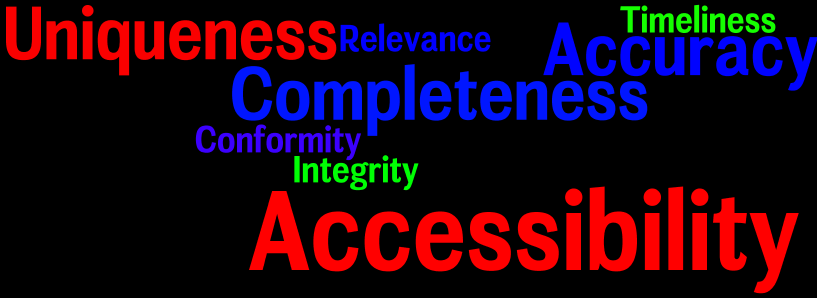
Data quality will probably increase with multiple uses as the accuracy and timeliness is probed with each use, a new conformity requirement may be discovered and the completeness may be expanded.

The usefulness of data (as information) may also be increased by each new use as new relations to other pieces of data are recorded.

In my eyes the value of (used) data is very much relying on how well you are able to capture the feedback from how data is used in business processes. This is actually the same approach as in continuous quality improvement (Kaizen) in manufacturing, only here the improvement is only good for the next goods to be produced. In data management we have the chance to improve the quality and value of already used data.    

Bookmark and Share

Does One Size Fit Anyone?

Following up on a recent post about data silos I have been thinking (and remembering) a bit about the idea that one company can have all master data stored in a single master data hub.

Supply Chain Musings

If you for example look at a manufacturer the procurement of raw materials is of course an important business process.

Besides purchasing raw materials the manufacturer also buys machinery, spare parts for the machinery and maintenance services for the machinery.

Like everyone else the manufacturer also buys office supplies – including rare stuff as data quality tools and master data management consultancy.

If you look at the vendor table in such a company the number of “supporting suppliers” are much higher than the number of the essential suppliers of raw materials. The business processes, data structures and data quality metrics for on-boarding and maintaining supplier data and product data are “same same but very different” for these groups of suppliers and the product data involved.

Supply Chain Centric Selling

I remember at one client in manufacturing a bi-function in procurement was selling bi-products from the production to a completely different audience than the customers for the finished products. They had a wonderful multi-domain data silo for that.

Hierarchical Customer Relations

A manufacturer may have a golden business rule saying that all sales of finished products go through channel partners. That will typically mean a modest number of customers in the basic definition being someone who pays you. Here you typically need a complex data structure and advanced workflows for business-to-business (B2B) customer relationship management.

Your channel partners will then have customers being either consumers (B2B2C) or business users within a wider range of companies. I have noticed an increasing interest in keeping some kind of track of the interaction with end users of your products, and I guess embracing social media will only add to that trend. The business processes, data structures and data quality metrics for doing that are “same same but very different” from your basic customer relationship management.

Conclusion

The above musings are revolved around manufacturing companies, but I have met similar ranges of primary and secondary constructs related to master data management in all other industry verticals.   

So, can all master data in a given company be handled in a single master data hub?

I think it’s possible, but it has to be an extremely flexible hub either having a lot of different built-in functionality or being open for integration with external services.

Bookmark and Share