When doing B2C (business-to-consumer) activities often you really want to do B2H (business-to-household). But sometimes you also actually want B2C, having a dialogue with the individual customer. So yet again we have a Party Master Data hierarchy, here households each consisting of one or several consumers (typically a nuclear family). In Data Model language there is a parent-child relationship between households and consumers.
The classic reason for wanting to identify households is that it’s a waste of money sending several printed catalogues and other offline mailings to the same household. But a lot of other good reasons based on a shared household budget exist too.
Data captured about consumers could look like this (name, address, city):
- Margaret Smith, 1 Main Street, Anytown
- Margaret & John Smith, 1 Main Str, Anytown
- John Smith, 1 Main Street, Anytown
- Peggy Smith, 1 Main Street, Anytown
- Mr. J. Smith, 1 Main Street, Anytown
Here it seems fair to assume that we have:
- A HOUSEHOLD being the Smith family consisting of
- A CONSUMER being Margaret nicknamed Peggy
- And a CONSUMER being John
(About party master data entity types please have a look here.)
But this is an easy example compared to what you see when working with names and addresses. Among complications I have seen are:
- Households consisting of individuals with separate family names
- Multi adult generation households and other kinds of households
- Not having unique addresses may cause forming not existing households
- Some addresses are not for traditional households, but are nursing homes, campus residence halls and the like
- The time dimension: un-synchronous relocation capture, marriage (couples), divorce (split)
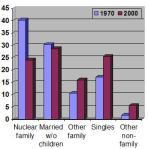 In other words: The real world is not that simple and the picture of how households are forming does change.
Available composable methods for maintaining household information are:
- Ask your customers. An obvious choice but not easy to keep on going – your ROI may not be positive.
- Fuzzy Data Matching. The higher percent of all citizens in a given region you have in your database the better your matching may be aligned with the real world.
- Exploiting external reference data. Having knowledge about public address data helps a lot. Such data may tell you about uniqueness of addresses and the attributes of the buildings there. Availability differs around the world, but the trend in open government data may help.
This is the second post in a series around hierarchies in Party Master Data and how this must be handled in data matching. Previous post was about B2B (E2E) data. Next post planned is about SOHO’s.

 Liliendahl on Data Quality