Skip to content
  • Home
  • Data Quality 3.0
    • Product Data Lake
      • Product Data Lake Documentation and Data Governance
      • Business Benefits
      • Become a Product Data Lake Commissioner
    • Big Data Quality
  • Master Data Share
    • Data Matching
      • Human interaction
      • Match Destinations
      • Match Techniques
      • Types of Party Master Data
    • MDM 101
  • About Henrik Gabs Liliendahl
    • My Been Done List
    • The Emperor’s new clothes
  • What I Do
    • Popular Offerings
      • Resources
    • MDM / PIM / DQM Tool Selection Consultancy

Liliendahl on Data Quality

A blog about Master Data Management, Product Information Management, Data Quality Management and more

Product Data Syndication

What a PIM-2-PIM Solution Looks Like

30th October 201611th August 2018Henrik Gabs LiliendahlLeave a comment

The importance of having a viable Product Information Management (PIM) solution has become well understood for companies who participates in supply chains.

The next step towards excellence in PIM is to handle product information exchange (product data syndication) in close collaboration with your trading partners. Product Data Lake is the solution for that. Here upstream providers of product information (manufacturers and upstream distributors) and downstream receivers of product information (downstream distributors and retailers) connect their choice of in-house PIM solution or other product master data solution as PLM (Product Lifecycle Management) or ERP.

The PIM-2-PIM solution resembles a social network where you request and accept partnerships with your trading partners from the real world.
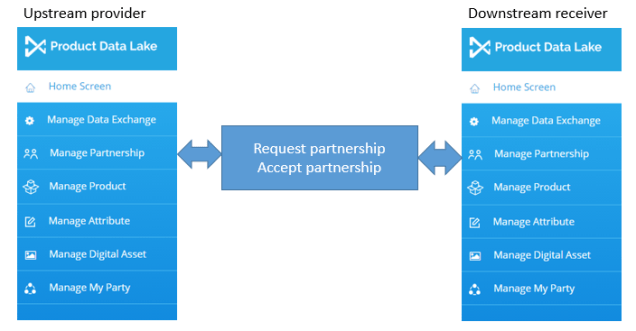
pdl-how-1

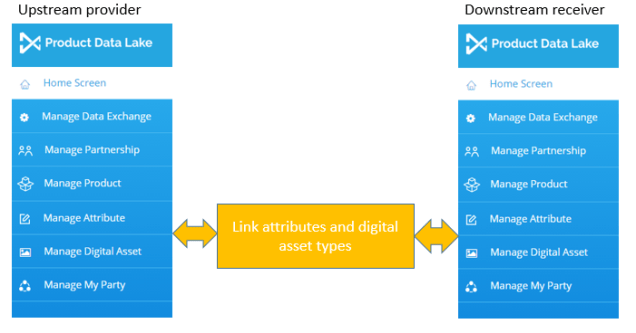
After connecting the next to set up is how your product attributes and digital asset types links with the one used by your trading partner. In Product Data Lake we encompass the use of these different scenarios (in prioritized order):

  • You and your trading partner uses the same standard in the same version
  • You and your trading partners uses the same standard in different versions
  • You and your trading partner uses different standards
  • You and/or your trading partners don’t use a public standard

Read more about that and the needed data governance in the post Approaches to Sharing Product Information in Business Ecosystems.
pdl-how-2

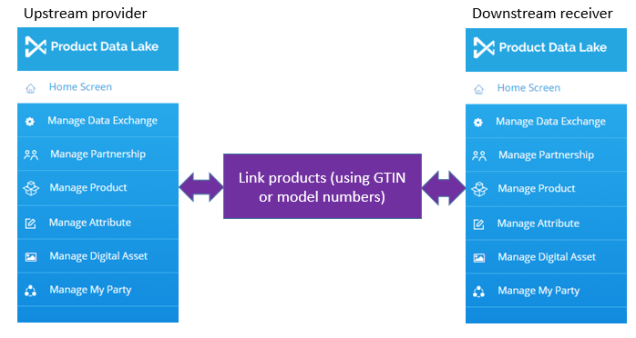
Then it is time to link your common products. This can be done automatically if you both use a GTIN (or the older implementations as EAN number or UPC) as explained in the post Connecting Product Information. Alternatively, model numbers can be used for matching or, as a last option, the linking can be done in the interactive user interface.
pdl-how-3

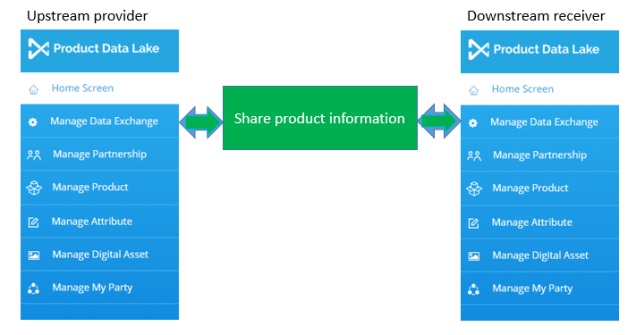
Now you and your trading partner are set to start automating the process of sharing product information. In Product Data Lake upstream providers of product information can push new products, attribute values and digital assets from the in-house PIM solution to a hot folder, where from the information is uploaded by Product Data Lake. Downstream receivers can set up pull requests, where the linked product information is downloaded, so it is ready to be consumed by the in-house PIM solution.
pdl-how-4

This process can now be repeated with all your other trading partners, where you reuse the elements that are common between trading partners and build new linking where required.
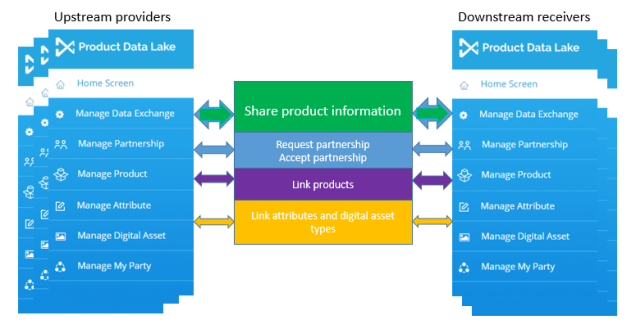
pdl-how-5

If you have any questions, please contact me here:

Go back

Your message has been sent

Warning
Warning
Warning
Warning

Warning.

Bookmark and Share

Like Loading...
Data Architecture, Data Matching, Master Data, Metadata, Product Data SyndicationMDM, PIM, Technology
Next Articles

The Disruptive MDM / PIM / DQM List

Register your innovative solution on the disruptive list of MDM/PIM/DQM/DAM solutions here

Select your MDM / PIM / DQM solution

Get a free solution ranking based on your context, scope and requirements here

Enter your email address to follow this blog and receive notifications of new posts by email.

Join 704 other subscribers

Let product data flow easily between trading partners

Product Data Lake: Put and Take

Product Data Lake: Put and Take

Categories

  • Big Reference Data (158)
  • Business Process Management (36)
  • Data Architecture (256)
  • Data Governance (157)
  • Data Matching (221)
    • Business Directories (24)
    • Identity Resolution (61)
    • Survivorship (10)
  • Data Profiling (16)
  • Data Quality Tools (180)
  • Data Quality World Tour (19)
  • Direct Marketing (19)
  • Environmental Data Management (2)
  • Information Quality (156)
  • Master Data (594)
    • Hierarchy Management (39)
    • Multi-Domain MDM (127)
    • Multienterprise MDM (27)
    • National ID (22)
    • Social MDM (60)
  • Metadata (25)
  • Product Data Syndication (51)
  • Product Information Management (27)
  • Search and navigation (15)
  • Service Oriented Architecture (12)
  • Social Media (78)
  • Sport (16)
  • Supposed to be a joke (66)
  • X-mas (20)

Data Governance Training

Getting Started in Data Governance online training from Nicola Askham is available here.

Recent Posts

  • Balancing the Business Partner / Party Concept
  • The Intersection of Data Observability, MDM and Data Quality
  • Product vs Material vs Article vs Item
  • Data Matching Efficiency
  • The Intersection Between MDM, PIM and ESG
  • The 4 Best Emerging Modern Data Quality Tools for 2024
  • Modern Data Quality at Scale using Digna
  • Three Essential Trends in Data Management for 2024
  • Modern Data Quality: Navigating the Landscape
  • From Platforms to Ecosystems

eLearningCurve

Have a look at the eLearningCurve course on data parsing, data matching and de-duplication here.

Recent Comments

Henrik Gabs Liliendahl's avatarHenrik Gabs Lilienda… on Balancing the Business Partner…
Jeppe Thing Sørensen's avatarJeppe Thing Sørensen on Balancing the Business Partner…
peolsolutions's avatarpeolsolutions on MDM, Cloud, SaaS, PaaS, IaaS a…
Henrik Gabs Liliendahl's avatarHenrik Gabs Lilienda… on Is the Holiday Season called C…
Michael D.'s avatarMichael D. on Is the Holiday Season called C…
Jay Ram's avatarJay Ram on The Disruptive MDM List is…
Henrik Gabs Liliendahl's avatarHenrik Gabs Lilienda… on The Intersection of Data Obser…
Shanker's avatarShanker on The Intersection of Data Obser…
Bhavani Shanker's avatarBhavani Shanker on Data Matching Efficiency
Henrik Gabs Liliendahl's avatarHenrik Gabs Lilienda… on Data Matching Efficiency
Bhavani Shanker's avatarBhavani Shanker on Data Matching Efficiency
Henrik Gabs Liliendahl's avatarHenrik Gabs Lilienda… on From Platforms to Ecosyst…
Michael Fieg's avatarMichael Fieg on From Platforms to Ecosyst…
Unknown's avatarFrom Platforms to Ec… on What is Collaborative Product…
Unknown's avatarFrom Platforms to Ec… on MDM and Knowledge Graph

Doing IT The Toyota Way

Addresses AI B2B B2C Big data Business ecosystems Business intelligence Business processes Business rules CDI CDP Cleansing Compliance Copenhagen CRM Cuisine D&B DAM Data Governance Data model DataQualityPro Digitalization Diversity DQM Duplicates ecommerce ERP Evolution Facebook Fit for purpose Fraud Fuzzy logic Gartner GDPR Geocode Graph Hans Christian Andersen Happy databases History Household Instant Data Quality IoT Laissez faire LEI LinkedIn London Mashup MDM MDMDG Metadata Migration Multi-Channel National identification number OCDQ Online Offline Open data People PIM Prevention Privacy RDM Real world alignment ROI Shakespeare Single version of the truth SOA components Standardisation Standardization Syndication Technology The cloud The world Twitter User involvement Who what where when

Blog stats

  • 629,136 visits

Enter your email address to subscribe to this blog and receive notifications of new posts by email.

Join 704 other subscribers
Blog at WordPress.com.
  • Subscribe Subscribed
    • Liliendahl on Data Quality
    • Join 704 other subscribers
    • Already have a WordPress.com account? Log in now.
    • Liliendahl on Data Quality
    • Subscribe Subscribed
    • Sign up
    • Log in
    • Report this content
    • View site in Reader
    • Manage subscriptions
    • Collapse this bar
 

Loading Comments...
 

    Privacy & Cookies: This site uses cookies. By continuing to use this website, you agree to their use.
    To find out more, including how to control cookies, see here: Our Cookie Policy
    %d