Skip to content
  • Home
  • Data Quality 3.0
    • Product Data Lake
      • Product Data Lake Documentation and Data Governance
      • Business Benefits
      • Become a Product Data Lake Commissioner
    • Big Data Quality
  • Master Data Share
    • Data Matching
      • Human interaction
      • Match Destinations
      • Match Techniques
      • Types of Party Master Data
    • MDM 101
  • About Henrik Gabs Liliendahl
    • My Been Done List
    • The Emperor’s new clothes
  • What I Do
    • Popular Offerings
      • Resources
    • MDM / PIM / DQM Tool Selection Consultancy

Liliendahl on Data Quality

A blog about Master Data Management, Product Information Management, Data Quality Management and more

Metadata

Data Accessibility

12th January 20128th May 2012Henrik Gabs Liliendahl2 Comments

When solving data quality issues we are usually dealing with important data quality dimensions as uniqueness, completeness, timeliness, accuracy, consistency and integrity.
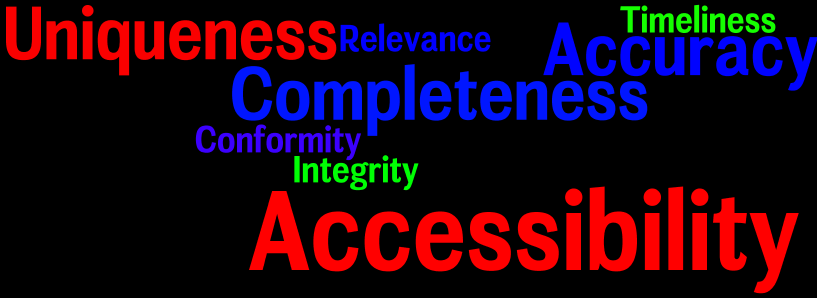
One other data quality dimension I have been addressing lately is accessibility.

Data accessibility is a universal feature within information technology as recently emphasized in the big story about that the Spanish bank BBVA is to move +100,000 employees to the cloud (using Google Apps). The main driver for that is data accessibility.

The increasing adoption of cloud services will in my eyes contribute positively to solving many data quality issues through improved accessibility as discussed in the post Data Quality from the Cloud.

The fact that data is available and in principle accessible doesn’t however mean that the case is solved. The Achilles Heel is how to smoothly integrate accessible data into business processes, not at least how to integrate and present data from many different sources be that external and internal sources.

Data accessibility must be seen in conjunction with the other data quality dimensions. Fulfilling one dimension doesn’t make the day. Accessibility to data that isn’t satisfactory unique, complete, timely and accurate isn’t that much worth. Making data consistent across multiple sources isn’t a walkover. Securing data integrity between more and more accessible data will be paramount.

Metadata management is also closely related to data accessibility. The importance of a common understanding about what is in the accessible data can’t be overestimated.

My guess is that we will see data accessibility as an increasingly important data quality dimension in the years to follow.


Bookmark and Share

56.085053 12.439756
Like Loading...
Big Reference Data, MetadataBusiness processes, The cloud

Metadata Meatballs

21st February 201116th November 2013Henrik Gabs Liliendahl5 Comments

I can’t help making analogies between data quality and food and drink even that I am actually not on any kind of diet these days.

Today’s subject is the similarities between metadata and meatballs.

Metadata is loosely defined as data about data. Some data describing what is meant to be in a dataset and a data element, what the purpose is and what standards are used.

The problem with metadata is if everybody understands the same when you use a certain term when creating metadata. Despite best intensions there will probably always be someone, somewhere getting something different from your wordings.

Frikadeller

That’s where meatballs come into the context.

If you read the article about meatballs on Wikipedia you’ll get the picture. Yes, meatballs have some common characteristics around the world. Some minced meat (or fish (if not vegetarian style)) mixed with some additional ingredients exposed to heat in some way and served with something different depending on where on earth you are.

Having a metadata repository is good for data and information quality.

The challenge in filling out a metadata repository is the balancing between describing how meatballs should be (your mom’s recipe) and how meatballs could be.

Bookmark and Share

55.646340 12.549496
Like Loading...
MetadataCuisine, Diversity

Football is FIFA

11th May 20102nd September 2010Henrik Gabs LiliendahlLeave a comment

Today we are only one month from the start of the biggest single-sport event in the world this year: The 2010 FIFA World Cup taking place in South Africa.

Now, shouldn’t the name be The Football World Cup?

Well, the problem is that football is a different game in some parts of the world like football is considered what is American Football in Northern America and Australian Football down under. The football we now in most other parts of the world is known as soccer in these areas. Association Football is the technically correct name, which is also why the acronym FIFA is an abbreviation of Fédération Internationale de Football Association which is French for International Federation of Association Football.

So, to avoid confusion the FIFA World Cup is the common – and official – name of the event.

Such naming difficulties are a very common source of information quality issues. In my work with global party master data I meet the naming issue daily – or on a daily basis as some might put it. Examples:

  • The first name is the family name in some parts of the world – so given name is a better term
  • ZIP code is technically only the US system – so postal code is a better term
  • SSN (Social Security Number) is only used in some countries. National identification number is used on Wikipedia, but I also like Citizen ID as a national identification number also might apply to companies.

The discipline concerning with unique naming of data is called Metadata Management – or Meta Data Management by some.

Bookmark and Share

55.580294 12.282991
Like Loading...
Metadata, SportDiversity, Metadata

Meterencedata

26th April 201026th April 2010Henrik Gabs Liliendahl2 Comments

Today I will like to invent a new word.

The word ”Meterencedata” is a combination of the two terms:

  • Metadata and
  • Reference Data

Metadata is data about data. Roughly spoken; in relation to databases and spreadsheets metadata describes what is in the columns.

Reference Data are high level value lists that categorize the data. Roughly spoken; in relation to databases and spreadsheets reference data explains what is in the rows.

Data Management activities – like Data Quality improvement, Master Data Management and Data Migration – will be (and have I seen are) like working in the dark if you don’t know the Metadata – and the Reference Data.

Data Models may look different. Some information may be understood through metadata in a model but through reference data in another model.

Example:

  • In one data model there are three columns in a customer table with corresponding describing metadata for:
    • Fixed line telephone number
    • Cell phone number
    • Fax number
  • In another data model there are a phone type reference table explaining the values in a separate phone table under (as a child to) the customer table having the columns:
    • Phone type
    • Phone number

In the latter case the original phone types may have been the classic fixed line, cell and fax but the entries may have been extended over time as the real world changes. This model also reflects the reality of several same type numbers attached to a single party.

Conclusion: One man’s Metadata is another man’s Reference Data as you don’t meet and mete out the data equal ways.

55.580294 12.282991
Like Loading...
Data Architecture, Data Governance, MetadataData model, MDM, Metadata, Migration

Perfect Wrong Answer

9th January 20109th May 2010Henrik Gabs Liliendahl4 Comments

If you ask me the question ”How many people live in your town?” I could give you a correct answer being 5,000 % besides what you are looking for.

I live in Greve Municipality in Denmark. Population close to 48,000. Greve is a suburb south of Copenhagen. According to Wikipedia Copenhagen urban area has a population of 1.2 million and Copenhagen metro area has a population of 1.9 million people.

The Copenhagen metro area stretches from 40 km (20 miles) south of the city to 40 km (20 miles) north at Elsinore and Kronborg Castle (immortalized in Shakespeare’s Hamlet – always remember to include Shakespeare in a blog).

Further more: From Copenhagen you can look across the water to the east seeing Sweden and the city Malmoe. The Copenhagen-Malmoe bi-national urban agglomeration has a total population of 2.5 million people.

The real data quality issue in my initial question is not the precision, validity and timeliness in the number given in the answer but the shared understanding of the label attached to the number.

I noticed that Wikipedia has developed a good metadata habit when stating town populations giving 3 distinct labels: City, Urban and Metro.

55.580294 12.282991
Like Loading...
Data Governance, MetadataCopenhagen, Fit for purpose, Metadata, Shakespeare, Single version of the truth, The world
Next Articles

The Disruptive MDM / PIM / DQM List

Register your innovative solution on the disruptive list of MDM/PIM/DQM/DAM solutions here

Select your MDM / PIM / DQM solution

Get a free solution ranking based on your context, scope and requirements here

Enter your email address to follow this blog and receive notifications of new posts by email.

Join 704 other subscribers

Let product data flow easily between trading partners

Product Data Lake: Put and Take

Product Data Lake: Put and Take

Categories

  • Big Reference Data (158)
  • Business Process Management (36)
  • Data Architecture (256)
  • Data Governance (157)
  • Data Matching (221)
    • Business Directories (24)
    • Identity Resolution (61)
    • Survivorship (10)
  • Data Profiling (16)
  • Data Quality Tools (180)
  • Data Quality World Tour (19)
  • Direct Marketing (19)
  • Environmental Data Management (2)
  • Information Quality (156)
  • Master Data (594)
    • Hierarchy Management (39)
    • Multi-Domain MDM (127)
    • Multienterprise MDM (27)
    • National ID (22)
    • Social MDM (60)
  • Metadata (25)
  • Product Data Syndication (51)
  • Product Information Management (27)
  • Search and navigation (15)
  • Service Oriented Architecture (12)
  • Social Media (78)
  • Sport (16)
  • Supposed to be a joke (66)
  • X-mas (20)

Data Governance Training

Getting Started in Data Governance online training from Nicola Askham is available here.

Recent Posts

  • Balancing the Business Partner / Party Concept
  • The Intersection of Data Observability, MDM and Data Quality
  • Product vs Material vs Article vs Item
  • Data Matching Efficiency
  • The Intersection Between MDM, PIM and ESG
  • The 4 Best Emerging Modern Data Quality Tools for 2024
  • Modern Data Quality at Scale using Digna
  • Three Essential Trends in Data Management for 2024
  • Modern Data Quality: Navigating the Landscape
  • From Platforms to Ecosystems

eLearningCurve

Have a look at the eLearningCurve course on data parsing, data matching and de-duplication here.

Recent Comments

Henrik Gabs Liliendahl's avatarHenrik Gabs Lilienda… on Balancing the Business Partner…
Jeppe Thing Sørensen's avatarJeppe Thing Sørensen on Balancing the Business Partner…
peolsolutions's avatarpeolsolutions on MDM, Cloud, SaaS, PaaS, IaaS a…
Henrik Gabs Liliendahl's avatarHenrik Gabs Lilienda… on Is the Holiday Season called C…
Michael D.'s avatarMichael D. on Is the Holiday Season called C…
Jay Ram's avatarJay Ram on The Disruptive MDM List is…
Henrik Gabs Liliendahl's avatarHenrik Gabs Lilienda… on The Intersection of Data Obser…
Shanker's avatarShanker on The Intersection of Data Obser…
Bhavani Shanker's avatarBhavani Shanker on Data Matching Efficiency
Henrik Gabs Liliendahl's avatarHenrik Gabs Lilienda… on Data Matching Efficiency
Bhavani Shanker's avatarBhavani Shanker on Data Matching Efficiency
Henrik Gabs Liliendahl's avatarHenrik Gabs Lilienda… on From Platforms to Ecosyst…
Michael Fieg's avatarMichael Fieg on From Platforms to Ecosyst…
Unknown's avatarFrom Platforms to Ec… on What is Collaborative Product…
Unknown's avatarFrom Platforms to Ec… on MDM and Knowledge Graph

Doing IT The Toyota Way

Addresses AI B2B B2C Big data Business ecosystems Business intelligence Business processes Business rules CDI CDP Cleansing Compliance Copenhagen CRM Cuisine D&B DAM Data Governance Data model DataQualityPro Digitalization Diversity DQM Duplicates ecommerce ERP Evolution Facebook Fit for purpose Fraud Fuzzy logic Gartner GDPR Geocode Graph Hans Christian Andersen Happy databases History Household Instant Data Quality IoT Laissez faire LEI LinkedIn London Mashup MDM MDMDG Metadata Migration Multi-Channel National identification number OCDQ Online Offline Open data People PIM Prevention Privacy RDM Real world alignment ROI Shakespeare Single version of the truth SOA components Standardisation Standardization Syndication Technology The cloud The world Twitter User involvement Who what where when

Blog stats

  • 629,406 visits

Enter your email address to subscribe to this blog and receive notifications of new posts by email.

Join 704 other subscribers
Blog at WordPress.com.
  • Subscribe Subscribed
    • Liliendahl on Data Quality
    • Join 704 other subscribers
    • Already have a WordPress.com account? Log in now.
    • Liliendahl on Data Quality
    • Subscribe Subscribed
    • Sign up
    • Log in
    • Report this content
    • View site in Reader
    • Manage subscriptions
    • Collapse this bar
 

Loading Comments...
 

    Privacy & Cookies: This site uses cookies. By continuing to use this website, you agree to their use.
    To find out more, including how to control cookies, see here: Our Cookie Policy
    %d